
Overview Summary
- Industrial parts washers are not one-size-fits-all. Process requirements should drive equipment selection.
- The right washer improves cleanliness consistency, throughput, and downstream quality.
- Key factors include part geometry, contamination type, production volume, and cleanliness standards.
- Integration with automation and materials handling is often as important as cleaning performance.
- Long-term operating costs and serviceability matter as much as upfront price.
Selecting an industrial parts washer is a critical decision that affects product quality, production efficiency, and long-term operating costs. Whether you’re replacing aging equipment or specifying a washer for a new line, the wrong choice can quickly become a bottleneck, or worse, a quality risk.
This guide walks through the most important considerations to help you choose an industrial parts washer that aligns with your facility’s real-world demands.
Start With Your Cleaning Requirements
Before comparing washer types or features, define what “clean” means for your operation.
Important questions to answer include:
- What contaminants must be removed (oils, coolants, chips, polishing compounds, fine particulates)?
- Are cleanliness levels visually acceptable, or must they be validated and measured?
- Do parts feed directly into assembly, coating, heat treating, or packaging after washing?
Facilities with strict cleanliness standards, especially those supplying regulated or precision-driven industries, often need repeatable, validated results rather than simple cosmetic cleaning.
Evaluate Part Size, Geometry, and Complexity
Part characteristics play a major role in determining the most effective washer design.
Consider:
- Overall part dimensions and weight
- Blind holes, internal passages, or complex geometries
- Fragility or surface sensitivity
Simple parts may clean well with conventional spray systems, while complex components often benefit from immersion, agitation, or ultrasonic energy to reach hidden surfaces. Choosing a washer that matches part geometry reduces rework and ensures consistent results.
Match Washer Type to Production Volume and Throughput
Your required throughput will narrow the field quickly. Low to moderate volumes often pair well with batch-style systems, such as cabinet or rotary basket washers. These systems offer flexibility for changing part mixes and are well-suited for facilities running multiple SKUs.
High-volume operations typically require continuous or conveyorized washers that integrate seamlessly into automated production lines. These systems prioritize speed, repeatability, and minimal operator intervention.
Consider Integration With Your Production Workflow
An industrial parts washer should support, not disrupt your manufacturing flow.
Key integration factors include:
- Compatibility with existing baskets, fixturing, or pallets
- Ability to integrate conveyors, robots, or automated load/unload systems
- Available floor space and plant layout constraints
Washer selection should account for how parts enter and exit the system, not just what happens inside the wash chamber.
Don’t Overlook Total Cost of Ownership
Upfront cost is only part of the equation. Long-term operating costs can far outweigh the initial investment.
Evaluate:
- Energy and water consumption
- Chemical usage and disposal requirements
- Maintenance access and wear-part replacement
- System uptime and service support
A more robust, well-engineered washer often delivers a lower total cost of ownership by reducing downtime, labor, and rework over the life of the system.
Address Safety and Environmental Considerations
Modern facilities increasingly favor aqueous cleaning systems that reduce solvent use and environmental risk.
When comparing equipment, look for:
- Enclosed designs that improve operator safety
- Proper ventilation and mist management
- Wastewater handling compatibility
- Compliance with applicable environmental and workplace standards
Choosing a system designed with safety and sustainability in mind helps future-proof your operation.
Plan for Validation, Documentation, and Scalability
For many manufacturers, documentation and validation support are just as important as cleaning performance.
The right industrial parts washer should offer:
- Process documentation and repeatability
- Support for cleanliness validation and testing
- Scalability for future throughput or part changes
Selecting a system that can adapt to evolving production needs avoids premature obsolescence.
Ransohoff Designs Real World Solutions
Ransohoff designs and builds industrial parts washing systems engineered around real production requirements. From rotary basket washers to fully automated, conveyorized cleaning systems, Ransohoff focuses on validated cleaning performance, seamless integration, and long-term reliability.
With process development support and a dedicated technical center, Ransohoff helps manufacturers specify equipment with confidence, ensuring the system performs as expected before it ever reaches the plant floor.
Need Assistance? Our Team is Here to Help
Choosing the right industrial parts washer is about more than selecting equipment. It’s about protecting quality, throughput, and profitability. By focusing on process requirements, integration needs, and long-term performance, manufacturers can avoid costly missteps and invest in a solution that delivers lasting value.
If you’re evaluating industrial parts washing options or planning a system upgrade, contact Ransohoff to discuss your application and explore the right solution for your facility.
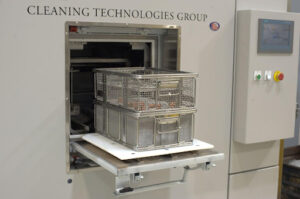 Why Rotary Basket Parts Washers Are Ideal for Small Batch Processing