Key Takeaways
- Conveyor parts washers provide continuous, repeatable cleaning for medium- to high-volume manufacturing operations.
- Conveyor configuration should match part geometry, orientation, production rate, and the way parts move through the rest of the manufacturing line.
- Mesh or flatwire belt systems work well for parts that can travel directly on a conveyor, while fixtured chain and monorail systems provide greater control over part positioning.
- Spray pressure is only one factor in cleaning performance. Nozzle placement, part orientation, chemistry, temperature, filtration, exposure time, and rinsing also influence results.
- Successful inline cleaning requires matching washer speed and controls to upstream and downstream production equipment.
- LeanVeyor can combine wash, rinse, drying, automation, and optional advanced cleaning stages within a continuous process.
When production volumes rise, parts cleaning can no longer operate as an isolated batch process without potentially affecting the rest of the line. Parts must enter the cleaning system at a predictable rate, meet the required cleanliness specification, and exit ready for the next operation.
This is where a conveyor washer offers an advantage. Conveyor parts washers move components continuously through one or more cleaning, rinsing, and drying stages. When properly engineered, the washer becomes part of the production flow rather than a separate operation requiring repeated loading, unloading, and material handling.
The challenge is choosing the right conveyor configuration and cleaning process for the application.
How Does a Conveyor Washer Work?
A conveyor washer transports parts through a defined cleaning sequence at a controlled rate. Depending on the application, that sequence may include:
- Spray washing
- Multiple rinse stages
- Blow-off
- Heated or high-velocity air drying
- Cooling
- Corrosion protection
- Filtration
- Ultrasonic or immersion cleaning
Unlike a batch washer, which processes a fixed quantity of components during each cycle, conveyor parts washers continuously accept and discharge parts. This makes them particularly useful when cleaning needs to keep pace with machining, stamping, assembly, coating, or other high-volume manufacturing processes.
The conveyor design itself is critical because it determines how parts are presented to the cleaning process.
Mesh Belt and Flatwire Belt Washer Systems
A belt washer is one of the most straightforward approaches to continuous parts cleaning. Components are placed directly onto a mesh or flatwire conveyor belt and transported through the cleaning stages.
This configuration can work well for machined components, stampings, fasteners, and other parts that remain stable while moving through the system.
Advantages can include:
- Simple loading and unloading
- Continuous high-volume processing
- Compatibility with automated material handling
- Minimal specialized fixturing
- Predictable processing time based on conveyor speed
Part orientation still matters. Spray cleaning depends heavily on mechanical impingement and access to contaminated surfaces. If parts overlap, nest together, or contain surfaces shielded from the spray pattern, simply increasing spray pressure may not solve the problem.
In those situations, custom fixtures or a different conveyor arrangement may provide better cleaning consistency.
When Fixtured Conveyor Parts Washers Make Sense
Some components need to remain in a defined position throughout cleaning. A conveyor system using custom fixtures attached to chains can provide greater control over orientation.
Fixturing can help expose critical surfaces to spray nozzles and keep sensitive components separated. It may also make automated loading and unloading easier because every component enters and exits the washer in a repeatable position.
The tradeoff is that fixtures introduce another engineering consideration. They must securely hold the component without blocking surfaces that need to be cleaned or creating areas where wash or rinse solution can collect.
For manufacturers running multiple part families, fixture flexibility should also be considered early in the design process.
Monorail Conveyor Washers for Large or Complex Parts
A monorail conveyor washer takes a different approach. Instead of carrying parts on a belt beneath them, components are suspended from an overhead conveyor, typically using custom hangers.
This can be especially useful for:
- Large stamped components
- Transmission components
- Remanufactured parts
- Components that already travel through the plant on an overhead conveyor
- Applications requiring controlled part orientation
A major advantage is integration potential. A monorail washer may be incorporated into an existing plant transport system or designed as a standalone conveyor loop.
Because components are suspended, spray can also reach areas that might otherwise be obstructed by a conventional belt.
What About Power-and-Free Conveyor Configurations?
Power-and-free material handling can be valuable when parts do not need to move through every production operation at exactly the same rate. Unlike a continuously moving conveyor, power-and-free configurations allow carriers to be routed, accumulated, stopped, or released according to the requirements of the production process. For complex automated lines, this can help decouple cleaning from other operations and provide greater control over work-in-process.
When a washer is being integrated with this type of material handling system, engineers need to evaluate more than the cleaning cycle. Carrier design, indexing, controls, accumulation requirements, load/unload timing, and communication with upstream and downstream equipment all become part of the system specification.
How Much Spray Pressure Does a Conveyor Washer Need?
There is no single ideal spray pressure for every conveyor washer. Higher pressure can increase mechanical impingement and help remove stubborn contamination, but pressure alone does not determine cleanliness. Effective spray cleaning depends on the complete process, including:
- Contaminant type
- Part geometry
- Nozzle design and positioning
- Distance between nozzle and part
- Solution chemistry
- Solution temperature
- Filtration
- Conveyor speed and exposure time
- Required final cleanliness
Spray cleaning is fundamentally a line-of-sight process. A high-pressure spray cannot effectively clean a passage or recessed surface it cannot adequately reach.
For parts with complex internal geometries, a combination of spray, immersion, agitation, or ultrasonics may be more effective than simply increasing pressure.
Integrating a Belt Washer Into the Production Line
For an inline cleaning system to succeed, washer throughput must be designed around the production process.
Start with the required production rate. If an operation produces 4,000 parts per shift, for example, the washer must reliably accommodate that volume while providing sufficient time for washing, rinsing, and drying. But nominal capacity is only the beginning.
Engineers should also consider:
- How parts arrive at the washer
- Required spacing and orientation
- Whether loading and unloading will be manual, robotic, or conveyor-fed
- Upstream and downstream cycle times
- Conveyor speed adjustments
- PLC and HMI integration
- Buffer or accumulation requirements
- Part detection and tracking
- Available floor space
- Maintenance access
A conveyor washer that cleans exceptionally well but cannot synchronize with the surrounding equipment can simply move the production bottleneck from one location to another.
Choosing the Right Conveyor Parts Washer Configuration
The best configuration comes from evaluating the complete application rather than selecting a machine based on throughput alone.
A mesh or flatwire belt washer may be appropriate when components can travel directly on the conveyor with adequate spray exposure. Fixtured chain conveyors can provide better control when orientation matters. Monorail systems can accommodate large or suspended components and integrate with overhead plant transportation.
More demanding applications may require multiple cleaning technologies within the same continuous system. Before specifying equipment, manufacturers should define the required cleanliness level, contamination being removed, part geometry, production rate, drying requirements, available space, automation requirements, and downstream process.
Testing actual production parts can be particularly valuable when cleanliness requirements are demanding.
LeanVeyor Conveyor Parts Washers for Continuous Production
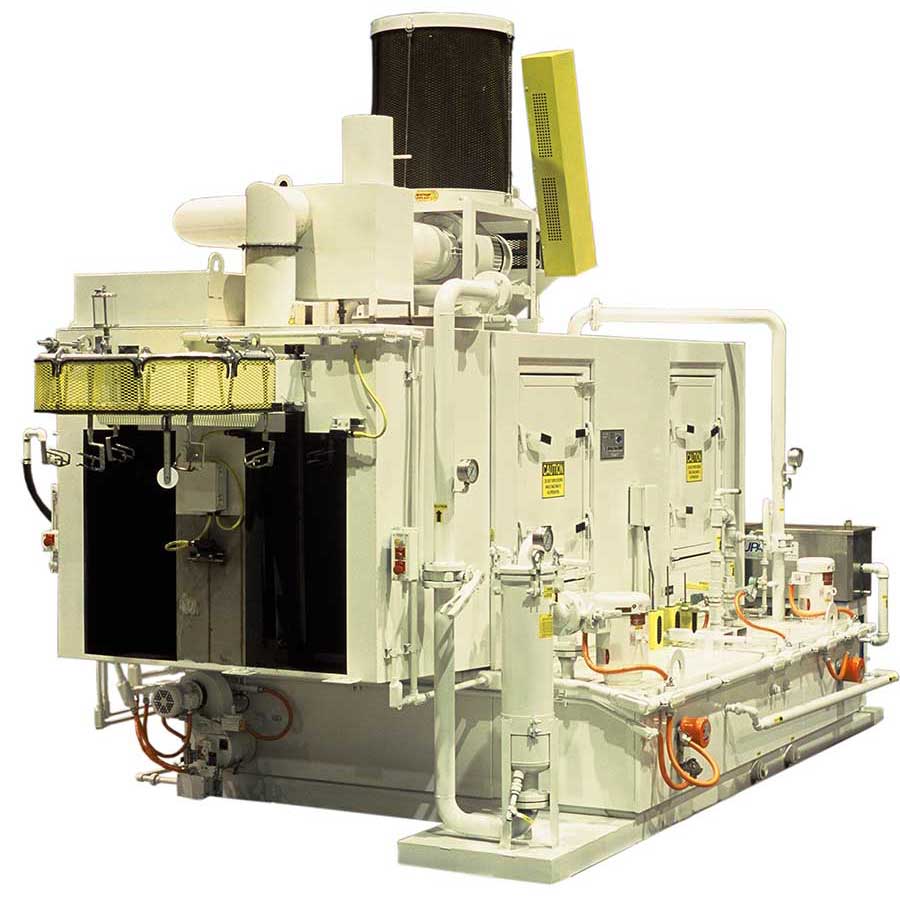
For applications suited to continuous conveyor cleaning, Ransohoff’s LeanVeyor is designed around lean manufacturing principles, combining high-volume processing with a compact, serviceable configuration.
LeanVeyor systems can process parts directly on a flatwire belt or on custom fixtures mounted to dual strands of chain. Configurations can include multiple rinse stages, automated loading and unloading, enhanced filtration, PLC/HMI controls, and additional process stages.
For applications involving complex internal geometries or more stringent cleanliness requirements, the Ultrasonic LeanVeyor can combine spray cleaning with immersion and ultrasonic technology.
We also engineer monorail conveyor washers for larger components and applications where an overhead material handling approach is a better fit.
The objective is not simply to put a washer in the line. It is to develop a cleaning process that matches the required production rate, part presentation, cleanliness specification, and surrounding automation.
Build Inline Cleaning Around Your Production Requirements
A well-designed conveyor washer can reduce manual material handling, provide consistent cleaning, and keep the cleaning operation synchronized with production. The right system begins with understanding exactly how the parts need to move, what needs to be removed, and what condition the parts must be in when they reach the next operation.
If you are evaluating a new conveyor parts washer or determining how an inline cleaning system could fit into an existing production line, contact the Ransohoff team. We can evaluate your parts, throughput, cleanliness requirements, and integration needs to help develop the appropriate cleaning process.