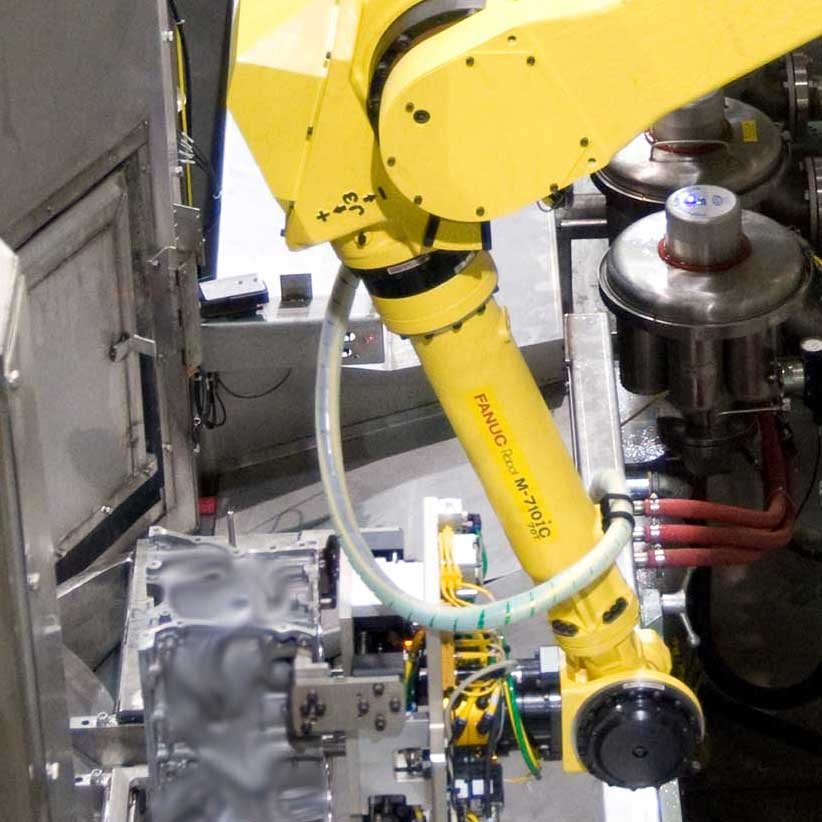
Industrial automation is moving beyond machining, assembly, and material handling. Parts cleaning can also be integrated into an automated production environment, reducing manual handling while creating a more controlled and repeatable process.
A robotic parts washer system can automate multiple steps, from loading and positioning parts to transferring them through cleaning, rinsing, drying, and unloading. For manufacturers evaluating automation or lights-out production, the cleaning process deserves to be considered as part of the overall production flow.
Key Takeaways
- The best industrial parts washer depends on part geometry, production volume, contamination type, and available floor space.
- Conveyor washers are ideal for continuous, high-volume production lines.
- Cabinet washers provide flexible batch cleaning for larger or mixed-part applications.
- Drum washers efficiently process large quantities of durable bulk parts such as stampings and fasteners.
- Basket washing systems offer exceptional flexibility for complex parts and multi-stage cleaning processes.
- Evaluating your production goals before purchasing a parts washer machine helps maximize throughput, cleaning quality, and long-term ROI.
What Is a Robotic Parts Washer?
A robotic parts washer combines industrial parts cleaning equipment with robotic material handling. Depending on the application, the robot may load parts into a washer, manipulate them during cleaning, transfer them between process stages, or unload clean and dry components for the next operation.
The goal is not simply to replace an operator with a robot. A successful robotic cleaning cell treats loading, cleaning, rinsing, drying, unloading, controls, safety, and upstream and downstream processes as one integrated system.
This can be particularly valuable when cleaning is currently a manual step between otherwise automated operations.
Labor Savings Without Creating a New Bottleneck
Loading and unloading a parts washer may appear straightforward, but repeated handling can consume substantial labor over multiple shifts.
Automation can reduce tasks such as:
- Loading individual parts or fixtures
- Reorienting components for cleaning
- Transferring parts between cleaning stages
- Removing parts after the wash cycle
- Moving cleaned components into downstream processes
The greater opportunity, however, is often maintaining production flow. An automated machining cell that repeatedly stops because someone must load or unload the washer is not truly automated from end to end.
Integrating robotic handling with the cleaning process can help keep parts moving while allowing employees to focus on tasks requiring judgment, troubleshooting, inspection, or other higher-value work.
Robotic Parts Washers Improve Cleaning Repeatability
Manual processes naturally introduce variation. One operator may position a component differently than another, or parts may enter a washer in inconsistent orientations. A robot performs the programmed movement repeatedly.
That consistency can be particularly important for components with blind holes, internal passages, complex geometry, or surfaces that must meet downstream cleanliness requirements.
Repeatable positioning also allows the cleaning equipment itself to be optimized around a known part location. Spray manifolds, nozzles, rinsing stages, and drying systems can be designed to address critical areas consistently rather than accommodating unpredictable positioning.
The result can be a more controlled cleaning process and greater consistency from part to part.
Supporting Lights-Out Manufacturing
Lights-out manufacturing generally depends on removing processes that require frequent operator intervention.
Parts cleaning can easily become one of those processes.
A robotic parts washer can potentially connect cleaning directly with CNC machining, deburring, inspection, assembly, coating, or other automated operations. Parts can move from one process to another without waiting for an employee to manually transfer them.
However, robotic handling alone does not create a lights-out cleaning process. The entire system must be designed for extended unattended operation.
Considerations may include:
- Automatic solution monitoring and controls
- Filtration and contaminant management
- Part presence and positioning sensors
- Fault detection
- PLC communication
- Process verification
- Automated drying
- Preventive maintenance requirements
- Safe recovery from process interruptions
The more autonomous the production goal, the more important these supporting systems become.
How to Select a Robot Arm for Parts Washing
Robot selection should begin with the application rather than a preferred robot model.
Payload: Calculate more than the weight of the part. The robot must safely handle the component, gripper or other end-of-arm tooling, and any fixture carried with it.
Reach: The robot needs access to pickup points, washer loading positions, process stations, and unloading locations without operating continuously at the edge of its working envelope.
Cycle time: Robot movements must support the required production rate. A system that cleans effectively but cannot match line speed simply moves the production bottleneck.
Environment: Heat, humidity, cleaning chemistry, water, mist, and other environmental conditions should be considered when selecting and locating robotic equipment.
End-of-arm tooling: Grippers must securely handle parts without damaging critical surfaces or interfering with cleaning.
These factors should be evaluated alongside the washer design rather than after the cleaning equipment has already been specified.
Fixturing Is Critical to Robotic Parts Washing
A well-designed robot cannot compensate for poor fixturing. Fixtures need to hold components securely while allowing the cleaning solution to reach the required surfaces. They should also encourage drainage so that water or chemistry does not become trapped in cavities.
Good fixture design considers:
- Part orientation
- Critical cleaning surfaces
- Spray accessibility
- Drainage
- Robot gripping points
- Changeover requirements
- Part-to-part variation
- Downstream unloading or transfer
For facilities running multiple components, flexible or interchangeable fixtures may be required. In some applications, robotic handling itself can provide greater flexibility by allowing different part programs and orientations without extensive mechanical changeover.
Integrating Robots with Existing Parts Washers
Robotic automation does not always require replacing the entire cleaning system. An existing parts washer may be a candidate for robotic loading and unloading if its process performance, physical configuration, controls, and access points are suitable for integration.
The evaluation should consider whether the existing machine can communicate with the robot and production line, whether doors or loading mechanisms can operate automatically, and whether the washer can reliably support the required cycle time.
Safety guarding, sensors, PLC programming, part tracking, conveyors, and upstream or downstream equipment also need to function as a coordinated system.
In some cases, modifying an existing washer can provide a practical path toward greater automation. In others, a new system designed around robotic integration may provide better long-term performance and flexibility.
Calculating ROI for a Robotic Parts Washer
Labor reduction is one of the easiest automation benefits to quantify, but it should not be the only factor in an ROI calculation.
A more complete analysis can consider:
- Direct labor reduction or redeployment
- Increased production throughput
- Reduced work-in-process between operations
- More consistent cleaning quality
- Reduced part handling
- Lower scrap or rework associated with cleaning variation
- Ability to operate additional unattended hours
- Reduced dependence on operators for repetitive material handling
Manufacturers should also account for the complete investment, including the robot, end-of-arm tooling, fixturing, controls, guarding, washer modifications, programming, installation, and commissioning.
The relevant question is not simply, “How much does the robot cost?” It is whether the automated cleaning process lowers cost per part or increases productive capacity enough to justify the investment.
Designing an Automated Cleaning System Around the Entire Process
The strongest robotic parts washer applications are engineered as complete processes rather than separate pieces of equipment.
Ransohoff works with manufacturers to evaluate part geometry, contaminants, cleanliness requirements, production rate, material handling, available floor space, and integration requirements when developing industrial parts washing systems.
For new installations, robotic loading and unloading can be considered as part of the washer design from the beginning. For existing equipment, our team can also evaluate opportunities to re-tool or upgrade a parts washer with newer controls and other capabilities where appropriate.
The objective is to create a cleaning process that works with the production line rather than operating as an isolated step.
Is Robotic Parts Washing Right for Your Production Line?
Robotic integration is worth evaluating when manual cleaning operations are limiting throughput, consuming significant labor, introducing process variation, or preventing a production line from operating with less operator intervention.
The right solution depends on more than choosing a robot or a washer. Robot reach and payload, fixturing, cycle time, cleaning requirements, controls, material flow, and downstream operations all need to be considered together.
If you are evaluating a robotic parts washer, automating an existing cleaning process, or planning a new production line, contact the Ransohoff team. We can help evaluate your application and determine how cleaning and robotic material handling can be integrated into a reliable, repeatable production process.